Linda Evangelista once said: “We don’t wake up for less than $10 000 a day.” While I’m not as demanding or diva-ish as the supermodel, I also need a very good reason to get out of bed to trek the more than 30km to one of Johannesburg’s most popular shopping malls, Sandton City. On this particular day, there was a splendid reason to get going: Chanel. More specifically the opening of the relocated Chanel beauty and make-up boutique and the launch of Chanel Coco Mademoiselle Crush Absolu EDP.
More about this fragrance below. In the meantime, some pics of the Chanel boutique.
The theme was a Parisian café and being Chanel, it could only be très chic.
Bigger is not always better. But when it comes to creating a sense of luxury, this larger store does that in style.
This boutique is home to the brand’s skincare, make-up and fragrance ranges. So plenty to keep the eye, nose and wallet busy.
The seating area for private consultations gives an air of personalised exclusivity.
PS: When I was offered a cocktail at this event (and it wasn’t even 11am), I asked myself: “What would Coco do?” She would, so I did…
CHANEL COCO MADEMOISELLE CRUSH ABSOLU EDP
One of the things I admire about Chanel is that it doesn’t flanker the life out of its fragrances. Unlike its main competitor, which shall remain nameless. In this case I’m talking about the latest launch, Chanel Coco Mademoiselle Crush Absolu EDP.
The OG was launched way back in 2001. Created by then in-house perfumer Jacques Polge, it went on to become a major success for the French luxury house, often outselling the iconic No 5.
From the first spray of Crush Absolu you’ll know this is a Coco Mademoiselle. With some differences, of course. Otherwise, why bother with a flanker.
Litchi brings a noticeably sweet, slightly tropical element to this Olivier Polge composition, leading to the florals of fruity rose and jasmine.
“The OG was a definitive patchouli bomb and here again, it’s pronounced and distinctive in its earthy ways, along with vetiver.”
The OG was a definitive patchouli bomb and here again, it’s pronounced and distinctive in its earthy ways, along with vetiver. There’s also creamy vanilla and powdery amber in the mix.
It’s not as complex as its predecessor but has more depth and immediate gratification for a younger market that will also appeal to those older than its intended demographic.
The OG was the brand’s way of tapping into a younger market. That demographic is all grown-up now and Crush Absolu becomes the new way to get the elegant young’uns into Chanel.
Without getting pseudo-philosophical, that’s a cycle of life for you.
Inspired by my fellow bloggers, I also undertook a fragrance collection edit earlier this year. What I still loved and should keep, what I liked but could go. In the process, I came across three Alaïa fragrances, which I remember enjoying very much when they were launched last decade. How do I feel about them now? More about that below, but first a quick look at the designer Azzedine Alaïa and his significance.
ABOUT AZZEDINEALAÏA
Azzedine Alaïa came to prominence in the 1980s. His designs were very much in tune with the aesthetic of the decade. But he made it his own with the immaculate tailoring, clingy silhouettes and sculptural forms that he’d honed over the decades since his move from his country of birth, Tunisia, to Paris in 1956.
BEFORE PARIS: Azzedine Alaïa at the School of Fine Arts in Tunis in 1951. IMAGE: Azzedine Alaïa Foundation.
A self-confessed perfectionist – “Perfection is never achieved, so you need to go on working,” he said – he made a name for himself as a haute couturier at a time when the art was increasingly confined to houses with clients with deep pockets.
HANDS-ON PERFECTIONIST: Azzedine Alaïa with Linda Evangelista in 1984. Image: Sante D’Orazio.
Alaïa did many things unconventionally during his career, from being self-taught to refusing to show collections according to fashion week dictates. So his late entry into the fragrance business in 2015, with Alaïa EDP and then Alaïa EDP Blanche in 2016 and Alaïa EDP Nude in 2017, should come as no surprise. An extrait version of Alaïa was also launched in 2015 – alas, I haven’t tried that one.
What happens when the founder of a house dies? If you’re Giorgio Armani, Thierry Mugler and Karl Lagerfeld, among others, the fragrance side of the business continues. But when Alaïa died in 2017 at the age of 82, that was the end of the fragrance foray. Until recently, Alaïa fashion was under the direction of Belgian designer Pieter Mulier. And I must admire that sense of finality for the perfumes.
Read The Guardian obituary for more on the man, who is hailed as one of the great designers of the 20th century.
FASHION AS ART: In 2013, the Palais Galliera presented the first retrospective in Paris of Alaïa’s work. IMAGE: Ilvio Gallo.
ALAÏAMOMENTS
* Upon his arrival in Paris, he was employed in the workshops of Christian Dior for all of five days. He was fired for not having the correct paperwork. When John Galliano was dismissed from Dior in 2011, Alaïa refused the top job of creative director, knowing it would trap him in an endless cycle of fashion shows.
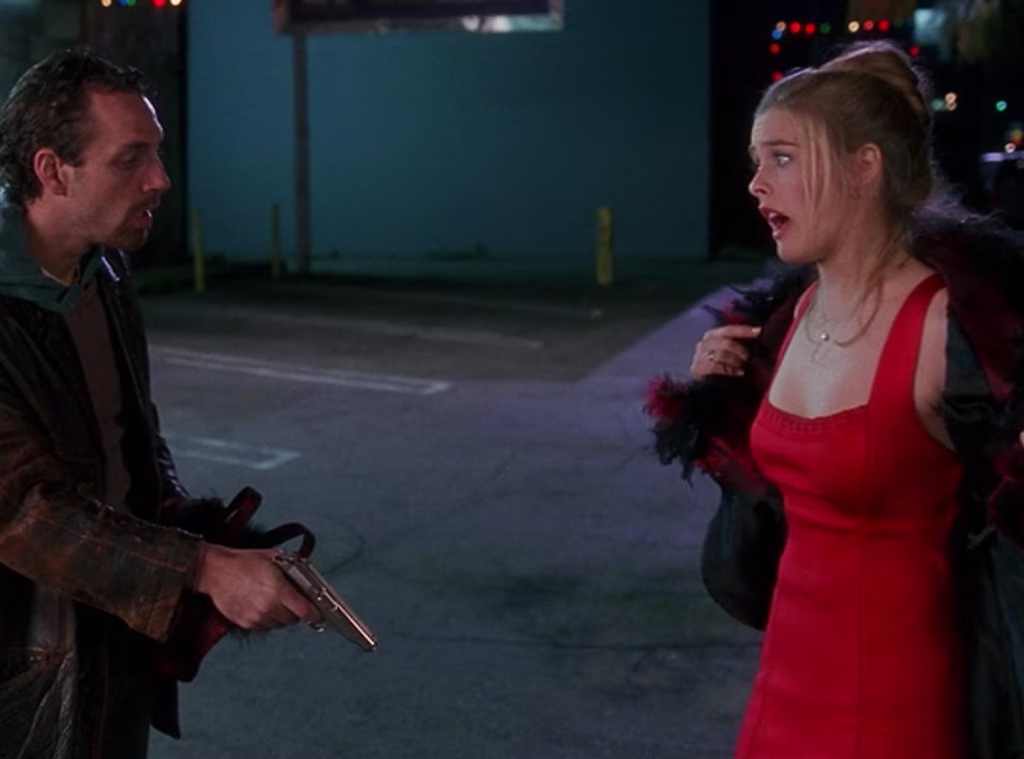
* In a perfect pop culture moment, in the 1995 film Clueless, the character Cher Horowitz (played by Alicia Silverstone) exclaims, “You don’t understand, this is an Alaïa!”, when she’s forced to lie on the ground by a mugger.
POP CULTURE PRINCESS: Alicia Silverstone wearing Alaïa in the cult-classic Clueless.
* Alaïa was an obsessive collector of the works of other couturiers, including more than 500 pieces by Christian Dior. These archives are remarkable histories of fashion and have gone on to become exhibitions in their own right, such as the recent Azzedine Alaïa’s Dior Collection in Paris.
COUTURE COLLECTOR: Part of the Azzedine Alaïa’s Dior Collection exhibition at La Galerie Dior in Paris in 2026. IMAGE: Adrien Dirand.
* When Naomi Campbell arrived in Paris at the age of 16, he gave her a home but insisted she obey his strict rules, including not going to nightclubs. In an interview with The Independent, the supermodel said: “I call him ‘Papa’ and we really do have a father-daughter relationship. When he’s pissed off with me, he picks up the phone and calls my mother.”
ALAÏA FRAGRANCES
All Alaïa fragrances were created by Marie Salamagne. And although they don’t have the hype of her other creations, including Guerlain Allegoria Mandarine Basilic EDT (2007), Maison Martin Margiela By The Fireplace EDT (2015), Atelier des Ors Lune Feline EDP (2015) and Gucci Flora Gorgeous Orchid EDP (2024), no doubt they played their part in her recently being recognised as a master perfumer by dsm-firmenich.
IMAGE: dsm-firmenich.
The bottles designed by Martin Szekely deserve a mention too. Minimalist but rich in meaning, the gold cap represents a golden spool of thread and the patterns on the bottles (also on the perfume boxes) are a nod to Tunisian geometry and the cut-outs Azzedine Alaïa became famous for.
ALAÏA EDP
Fragrance nerd fact: the debut fragrance from the Paris-based luxury fashion brand was awarded the top five stars in the most recent edition of the prestigious Perfumes: The Guide by Luca Turin and Tania Sanchez.
A contrast between cold and warm notes, the Tunisian-born designer wanted it to feel like a second skin. And that’s exactly what perfumer Marie Salamagne achieved with it.
The fresh and airy opening progresses to a floral heart with nuances of peony, freesia and rose, while leather and white musk define the drydown.
It’s an impeccably smooth, high-quality leather scent, with none of the aggressiveness that pervades the genre.
ALAÏA EDP BLANCHE
Vanilla has been over done for several years now, but this is how I love it: serene and soothing, even when it’s sweet and the main component of a scent. While memories of Tunisia inspired Alaïa EDP and Alaïa EDP Nude, Alaïa EDP Blanche was inspired by the designer’s visit to the Alhambra fortress and palace in Granada, Spain.
I haven’t had the pleasure of seeing this unique example of medieval Islamic architecture myself. But from reading about it and marvelling over the pics online, I get a strong sense of how Marie Salamagne interpreted the welcoming coolness of the fountains and pools with notes of almond, heliotropin and vanilla absolute.
ALAÏA EDP NUDE
There’s no place for tacky in the world of Azzedine Alaïa, so “nude” here is all about the sensuality of skin, with a large dose of the synthetic Cashmeran creating a suitably warm musky ambience. Cedarwood adds to the softness.
The skin-like mood continues with orange blossom pushed in a slightly animalic direction, with just the right amount of sweetness from tonka bean in the drydown.
If leather in Alaïa EDP is black and often cool, here it is fleshed out with the warmth of human touch.
I’ve been absent from the blogosphere (do we still use this term?) for some time – my last post was on 17 May 2026. The longest I’ve not posted since I got into the blogging thing. Wish I could say I’ve been away on an exotic beach holiday. But the reality is far more mundane.
Life, in the form of a new job* and all the relentless pressures and stress that came with it, meant I simply didn’t have the headspace or time to blog (although I did my best to keep up with many of your posts).
Fragrance during this time took on a different meaning for me. Often a functional spray and go, which didn’t require much thinking. Other times, in complete contrast, I kept on coming back to my bottle of Narciso Rodriguez Fleur Musc EDP.
OVER-THE-TOP APPEAL OF NARCISO RODRIGUEZ FLEUR MUSC
Part of the appeal of this discontinued 2017 release from the American designer brand is its borderline kitsch pink presentation. It smells over the top too. Narciso Rodriguez Fleur Musc EDP was co-created by Calice Becker and Sonia Constant at a time when the house stood out from its rivals with a more daring approach that made it one of my favourite brands.
Fleur Musc starts out with the soft floral spice of pink peppercorn and then boom, ROSE!, supported by the freshness of freesia. This isn’t a realistic garden rose. It’s rose taken in a dramatic, full-on direction, with lots of the Narciso Rodriguez signature musk and earthy patchouli upping the ante.
I didn’t know if I was coming or going at work, but with Fleur Musc I certainly knew what I was doing in this realm: living an escapist fantasy.
Some people think you shouldn’t wear fragrances you love during tumultuous periods due to the associations they might form. I’m not of that school and know that when I come back again to Fleur Musc, I’ll still relish its extravagant ways, but hopefully without any accompanying real-life drama.
*I’m using the past tense for this work situation, as I had to recognise my limitations and resign.
No, this is not a post about the ongoing gourmand obsession. It’s something altogether more existential, if you will.
As I was scrolling through a website offering pages upon pages of rip-offs / clones / dupes (never mind doom scrolling, this is ’fume scrolling), it occurred to me that perhaps we’ll get to the stage where there will rip-offs of rip-offs.
So picture the scene: we went from the hugely popular Maison Francis Kurkdjian Baccarat Rouge 540 to probably its most well-known rip-off, Fragrance World Barrakat Rouge 540.
Is it a step too far to imagine a clone of the latter? Let’s call it Barrakesh Rouge 540. That iteration, through the power of social media, becomes so popular, it leads to another clone. See where I’m going with this?
IMAGE: Fragrance World.
Of course, each clone becomes further removed from the original, so much so that it disappears into the mists of memory. Almost like a pop song that gets covered so regularly, it’s easy to forget who did the original.
Is this scenario far-fetched? Initially, I thought so. But as my scrolling, er, research on rip-offs continued and I come across more renditions of Maison Francis Kurkdjian Baccarat 540, maybe not.
IMAGE: Pendora Scents.
If you want to know why, for example, in the UK, perfume manufacturers can trademark their brand names, labels and bottle shapes, but not the scent of an original fragrance,read this informative piece from The Guardian.
*Disclaimer: While I don’t use AI in any of my other fragrance images, I found Microsoft’s Copilot very useful in helping to create some of these graphics with one of my OG images.
When I realised recently one of my favourite fragrances, Lalique Encre Noire EDT, marks its 20th year in production, I had to do something to celebrate this remarkable achievement. But how?
LALIQUE ENCRE NOIRE EDT: SO MUCH TO SAY…
I could say it’s the definition of a modern classic. But that’s obvious.
Or that it’s gone onto become a reference vetiver fragrance, along with Guerlain Vetiver EDT, Tom Ford Grey Vetiver EDP, Chanel Sycomore EDP and Carven Vetiver EDT.
Then there’s its huge crossover appeal in terms of male / female and designer / niche binaries.
And let’s not forget: it still offers unbeatable value at a time when fragrances have become ridiculously expensive.
Or that even with the success of the OG, it hasn’t been flankered to death. In fact, its flankers – Lalique Encre Noire Sport EDT (2013), Lalique Encre Noire A L’Extreme EDP (2015) and Lalique Encre Indigo EDP (2023) – have maintained and built on the quality of the OG with distinctive variations on the vetiver theme.
I could be clever and go into detail on the materials in the composition. How apart from Haiti vetiver and Bourbon vetiver, it also includes the hemi-synthetic (or semi-synthetic) Vetiveryl Acetate and the synthetic Cashmeran.
Or that the instantly recognisable bottle was inspired by the “Biches” inkwell designed by René Lalique in 1913, according to the Lalique website.
Oh, and its creator, master perfumer Nathalie Lorson, seems to have explored a similar inky theme in L’Artisan Parfumeur L’Amant EDP (2026). But I haven’t tried it yet, so what would I know…
How about mentioning it was one of the first fragrances I featured on my blog?
Yes, I could do all of that. Which I just have. Or I could just wear it. A lot. To feel its contrasts of freshness and darkness, earthiness and elegance. Can’t think of a better way to celebrate Lalique Encre Noire EDT, in fact.
It’s a small world, even more so in perfumery. I recently interviewed Antoine Lie about Puredistance Ysayo. And then I interviewed Guillaume Flavigny, who mentioned that he trained under Antoine Lie. After studying at ISIPCA between 1998 and 2000 and Givaudan’s Perfumery School until 2003, Guillaume Flavigny joined the Givaudan Paris team, where he worked with Antoine Lie for two years.
IMAGE: Givaudan.
No doubt, the master was a key figure in Guillaume Flavigny’s career development. And in the more than two decades since then, Guillaume Flavigny has gone onto become a highly respected creator himself, as evidenced by the list of some of his creations below:
+ Pierre Balmain Ambre Gris EDP (2008)
+ Guess Seductive Homme Blue EDT (2012)
+ Moschino Cheap & Chic Chic Petals EDT (2013)
+ Comme des Garçons Black EDT (2013)
+ Initio Divine Attraction EDP (2015)
+ Commodity Tonka EDP (2017)
+ Elizabeth Arden White Tea EDT (2017)
+ The Harmonist Yin Transformation Parfum (2018)
+ Valentino Uomo Born in Roma EDP (2019)
+ Tom Ford Rose Prick EDP (2020)
+ Sisley L’Eau Rêvée D’Isa EDT (2023)
+ Yves Rocher Bouquet Ambré EDP (2026)
I’m familiar with most of these perfumes, but it’s his 2025 creation for the Japanese designer brand, Comme des Garçons Max Richter 01 EDT, which reminded me just why Guillaume Flavigny has notched up several awards over the years.
This composition displays the creativity one would expect from CDG and a fragrance inspired by the music of Max Richter (a 2026 Oscar nominee for best original score for Hamnett). The brand has displayed synthetics in striking ways since its entry into fragrance in the 1990s. And Max Richter 01 EDT continues in that vein.
IMAGE: Max Richter.
You might scoff at the listed notes on the bottle: graphite, vetiver, piano soundboard cedar, Vn bow rosin, transistor and magnetic tape. But in this case, the artistic licence pays off with a fragrance that unmistakably evokes music instruments.
And while I don’t normally comment about performance, this EDT lasts an incredibly long time, a much-needed counterpoint to all those who look down on this concentration in the extrait de parfum era. More importantly, however, Comme des Garçons Max Richter 01 EDT is memorable in all the right ways.
You studied chemistry before going to ISIPCA. Has that technical background given you an advantage in perfumery?
You need chemistry to enter ISIPCA, but it’s not necessary for Givaudan’s Perfumery School.
“Like a musician puts sounds together, I mix different raw materials together to create a new story.” – Guillaume Flavigny
A perfumer doesn’t need chemistry, just passion, a great nose, an amazing memory and creativity. Perfumes are all about emotions and not chemistry. Like a musician puts sounds together, I mix different raw materials together to create a new story.
IMAGE: Yves Rocher.
Elizabeth Arden White Tea EDT (2017) is a fragrance I keep coming back to. Is it the kind of fragrance you’d wear yourself?
I love to take “a shower” with this perfume – it’s clean, easy and genderless, with a soft amber and a touch of orris. It’s one of my daughter’s favourites, along with Montblanc Signature EDP and Tom Ford Cherry Smoke EDP, which I also created.
You co-created Montblanc Signature EDP (2020) with your Givaudan colleague Natalie Gracia-Cetto. Do you find these collaborations easy, or do you prefer working on a composition by yourself?
It’s great to share, as you always learn from others. For Signature, it was my idea and Natalie came in at the end to fine-tune the perfume. I was working in New York at that time.
One of the things I love about Sisley L’Eau Rêvée D’Isa EDT (2023) is the big hit of oakmoss in the drydown. How did you get that effect without contravening the IFRA standards?
The chypre structure offers lots of elegance. To replace a part of the oakmoss, I played with Evernyl [the synthetic], amber, dry amber and vetiver.
IMAGE: Sisley.
Let’s talk about Comme des GarçonsMax Richter 01 EDT specifically. How did you go about creating it?
The idea was to translate music instruments, the metal of violin strings, the wood of a piano, the synthetic smell of a vinyl disc, the mood of a concert.
This perfume is a surprising and very rich mix – dark and luminous, black and white like a piano. I was very inspired because I love the music of Max Richter. I play the piano and I’m always working with music.
Were you familiar with the work of Max Richter before you started the project?
Yes, because of my father, who had a strong passion for music.
You also played with synthetics in Tom Ford Black Lacquer EDP to great effect. Is the fundamental value of synthetics getting lost in the push for more natural ingredients?
There is no conflict between naturals and synthetics. A good perfume is a mix of both. Some synthetics are much more expensive than many natural raw materials. I need synthetics for modernity, creativity and sometimes for their performance.
“There is no conflict between naturals and synthetics. A good perfume is a mix of both.” – Guillaume Flavigny
IMAGE: Tom Ford.
Max Richter 01 EDT is not your first fragrance for the brand. That would be Black (2013). Can we expect another collaboration with Comme des Garçonsin the future?
Oh, I hope so, yes. I’m working on it.
You’ve won quite a few awards in your career so far. Is there one that has particular significance for you?
Yes, the first award I received when I was still in Givaudan school in 2002, the international prize for the best young perfumer [Prix International du Jeune Parfumeur Createur].
And where do you keep your awards?
I keep the awards in my office. The last ones were for Rochas Eau de Rochas Citron Soleil EDT [Best Fragrance at the 2023 Prix Vénus Version Femina] and Valentino Born in Roma Donna EDP Intense [2024 Fragrance of the Year in the Women’s Luxury category at The Fragrance Foundation Awards].
I started wearing Puredistance Ysayo Extrait de Parfum in December last year. And I thought I had it all figured out in terms of my thoughts on this 2025 release from the Dutch niche brand. But then I interviewed its creator, Antoine Lie, in January and that changed. For the better.
IMAGE: Puredistance.
Antoine Lie scored numerous big commercial hits before he became an independent perfumer in 2018. Whether you’ve worn them or not, there’s a good chance you’ve come across creations such as:
+ Ralph Lauren Romance For Men EDT (1999)
+ Elizabeth Arden Beauty EDP (2002)
+ Versace Crystal Noir EDP (2004)
+ Armani Code EDT (2004)
+ Van Cleef & Arpels First Premier Bouquet EDP (2007)
+ Avon Far Away Exotic EDP (2012)
+ Tom Ford Café Rose EDP (2012)
+ Pharrell Williams Girl EDP (2014)
+ Davidoff Cool Water Wave EDT (2017)
IMAGE: Versace.
Even while working for the big fragrance companies, he was showing his creative flair with Etat Libre d’Orange Secretions Magnifiques EDP (2006) and Comme des Garçons Wonderwood EDP (2010).
Nowadays, Antoine Lie is very much his own man, with his own company, Antoine Lie Olfactive Experience. He can count brands such as Eris Parfums, Houbigant, Les Indémodables and Zoologist among his clients.
IMAGE: Les Indémodables.
Without a marketing department in one of the big fragrance firms filtering his thoughts, Antoine Lie speaks his mind directly and is particularly scathing about the industry’s current business model. Which helps explains why projects like Puredistance Ysayo appeal so much to him.
In this interview, we spoke about how he became an independent perfumer, the non-negotiables in the way he works now and the creation of Puredistance Ysayo. It’s not the first fragrance he’s created for the house. In fact, since he started working with brand founder Jan Ewoud Vos, he’s produced standouts such as Black (2013), White (2015), Warszawa (2016), Gold (2019) and Aenotus (2019), among others, for them.
When did you become an independent perfumer?
I began as an independent perfumer in 2018. Actually, I did not really decide on it as such, at first. Before that, I worked with big companies like Givaudan, IFF, and then Takasago from 2011. I don’t want to go into detail, but they decided to get rid of me.
I left Givaudan, because it’s a monster with teams of perfumers all working in one category with some clients, but not the others.
It’s not motivating in terms of inspiration and creativity because everything depends on evaluators, salespeople, marketing people, and consumer testing people. It became very boring and frustrating to me. I left Givaudan to have more freedom, then suddenly I was kicked out of Takasago without anticipating that turn of events.
IMAGE: Puredistance.
What did that unexpected turn of events force you to do?
I was forced to interrogate myself. What do I want to do? How do I want to finish my career? Do I want to go back to the big companies?
“I just want to talk with the brand owner. I refuse to talk to people from marketing and consumer testing. Those are my conditions.”
I consider myself as an artist. It means I just want to talk with the brand owner. And I don’t want any filters between me and the brand. I refuse to talk to people from marketing and consumer testing. Those are my conditions.
Because then you don’t think about the brand, you don’t think about the quality, you just think about the test, the analytical results. And then it becomes rational and not emotional.
NO FILTERS: Antoine Lie and Puredistance founder Jan Ewoud Vos in Paris. IMAGE: Puredistance.
And how’s that working for you?
It’s working great. I’ve got plenty of work, plenty of projects. And they respect the way I want to work. They know that there is a creation fee and that my conditions are to work with the dialogue and only with one person.
Do you ever miss working on high-profile projects, such as Armani Code (2004)?
Not at all. It’s even worse now than when I worked with them. They are into result, performance, the cheapest way possible to get the biggest amount of money.
Armani Code was an exception because it was supposed to be a flanker of something that is called Mania for Men. It was not completely formatted to hit the market. You still had, at the time, it’s more than 20 years ago now, humanity in the Armani team, people who have the conviction and power to do this sort of fragrance.
IMAGE: Giorgio Armani.
I’m glad you’re getting to work with clients that buy into your approach. Puredistance seems to get what you do.
It’s a long association that we have. Jan Ewoud [brand founder] gives me his idea that he expresses through words, sentences, pictures and textures. And then I translate what he wants. We’ve had a great fit since we began to work together on Puredistance Black in 2013 and White in 2015, which I developed while I was still at Takasago.
We respect each other because he saw I was completely frustrated with the way I was working, and I needed to have projects like this to allow me to reveal some creativity or some daring intention as well.
When you started working on Ysayo, what kind of fragrance did you imagine in your mind?
I remember that Jan Ewoud showed me visuals. It was about a man with experience in life doing introspection, cerebral in a way. And he showed me textures like underground, caves, where you get water dripping and moss. Darkness, a bit leathery as well.
It was how to mix touches of greenness, spiciness, woods (because it’s very patchouli as well), ambery parts, animalic parts, but without taking over the whole purpose.
INSPIRATION: Antoine Lie drew on imagery of a cave to create Ysayo. IMAGE: Puredistance.
Tell us about some of the ways in which you went about differentiating it.
I started to re-smell ingredients that I’d not used a lot before. Blue chamomile is a very specific ingredient – there’s an overdose of it in Ysayo that makes the difference, especially on top.
“Blue chamomile has different inflections. Of course, it’s aromatic, but there’s a touch of soft greenness, also a leathery quality to it.”
What I like about blue chamomile is that it has different inflections. Of course, it’s aromatic, but there’s a touch of soft greenness, there’s also a leathery quality to it. If you remove the blue chamomile, and maybe the celery as well, then you would end up with something a bit more déjà vu, more expected in a way.
The way you source your raw materials, that’s also important to you…
I work with L’atelier Français des Matières and Atelier Fragranze Milano. For Ysayo, I worked with L’atelier Français des Matières because Jan Ewoud wanted the best quality possible in terms of ingredients. I’m also part of the L’atelier team in terms of trying to develop new ingredients, so I guide them to let them know if it’s a good trial, or they must change parameters to get something better.
For the sourcing at L’atelier Français des Matières, Rémi Pulverail is in charge. He was a buyer for Givaudan, like, maybe 15 or 20 years ago. So he knows exactly where the good sources for ingredients are because he’s travelled the world.
Antoine Lie and Rémi Pulverail in the laboratory. IMAGE: Puredistance.
For the big companies, they are not just looking for the quality. They are looking for the best quantity at the best price, which is completely different.
For example, Rémy goes to the small producers that have great ingredients with very specific olfactive profiles. Instead of having one lavender oil, like, in a big company, where the buyers buy everything everywhere, and they are mixing all the things, and after that are just adjusting to make sure that it’s going to smell the same as last year… The industrial way.
For consistency?
Yeah, exactly. Rémy decided he wants to give the perfumers who work in his lab the possibility to use different olfactive profiles from, for example, lavender. We have four different lavenders coming from different places in France, all with distinctive profiles.
“If you’re a painter, suddenly instead of having one red, you’ve got nuances on the red.”
You get one that is warm, almost tonka chocolatey. Another one would be sparkling in a way. Some other would be very clean, very aromatic. Depending on the project you have, you may switch from one to another, which [chuckles] if you’re a painter, suddenly instead of having one red, you’ve got nuances on the red.
We are going directly to the source, directly to the producer, respecting them, and we are not trying to negotiate the price like the big company is doing. Basically, they put a lot of pressure on the price on those farmers. That’s the problem. And it’s like this, not just in perfumery, everywhere. That’s why the ingredients we have on our palette are more expensive than the one you can have with some other company.
It makes a difference. It’s a great perfume. The more I wear it, the more I’m enjoying it. I prefer to grow into something more than love it the first time, and then six months later, I’ve gone the other way.
Jan Ewoud was also saying something like that when I last met him.
The interesting thing is that now there is no filter between me and the people who are wearing the fragrance. They are sending me direct messages through Instagram, because I’m open to this and I’m visible on media, because I’ve got people that are taking care of my image as well… It’s not like I want to be present all the time, but when I’ve got something to say, I want to be able to present it in the best way possible.
A lot of people are loving Ysayo, that’s for sure. But it has a strong signature, so some people are going to love it, and others are going to say, “No, it’s not for me at all.” But that’s what I love. You don’t have something in between, like, “Yeah, okay. Well, so what?”
“I prefer it to be categoric in a way. That’s art, that’s the way it should be.”
I prefer it to be categoric in a way [chuckles]. That’s art, that’s the way it should be. In industrial perfumery, it’s the opposite. They just want everybody to love it, even though it smells like something that has already been done before.
MY THOUGHTS ON PUREDISTANCE YSAYO EXTRAIT DE PARFUM
I don’t usually list the raw materials in a fragrance, but for Ysayo (from the Puredistance website), it shows its quality and complexity:
Top notes: Saffron, Galbanum oil Iran, Blue Chamomile oil Egypt, White Artemisia oil Morocco.
Middle notes: Celery oil India, Geranium oil Egypt, Jasmine absolute India, Thyme oil France, Geranium oil Madagascar.
Base notes: Ciste absolute Spain, Patchouli oil Indonesia, leather, Vetiver oil Java and Haiti.
When I first started writing about Ysayo, I was going to focus on the two aspects that really stood out for me: the patchouli and vetivers. My conversation with Antoine Lie gave me a deeper appreciation of what went into the creation of this perfume.
Call it the power of suggestion (or education), but I now pick up more of the blue chamomile and how together with the galbanum (often a heavy-hitter), it gives Ysayo a softly green feel. Blue chamomile is also known for its hay-ish characteristics and that certainly comes through here.
IMAGE: Hermitage Oils.
The interplay between the herbal and aromatic aspects is never obvious, with one shouting out its presence more than the other. The same could be said for the jasmine, with its slightly sweet floralcy in the background.
I love how the spiciness of celery (slightly green too) leads to the more instantly recognisable earthiness of patchouli (a tad chocolate-y to me) and vetivers in the drydown.
Throughout the progression of Ysayo, there’s a leatheriness. This would come from the saffron, blue chamomile and labdanum. No doubt, a synthetic emphasises this side. It’s a smooth, lived-in leather, with just a hint of the animalic.
I wouldn’t hesitate to praise Ysayo for its elegance. But elegance can sometimes imply safe and boring too. With Ysayo’s abundance of character – or as Antoine Lie would call it, “signature” – there’s none of that here.
We all know the clichéd Instagramable images of fields and fields of the flowering stuff, but pretty pics aside, did you know lavender (scientific name Lavandula) is part of the mint family?
CARON CLASSIC: While not featured here, I’ve written previously about Pour Un Homme de Caron Parfum as one of my favourite lavender fragrances.
With its qualities ranging from clean, fresh and aromatic to spicy, liquorice-ish, floral and herbaceous, lavender is a mainstay of “masculine” fragrances and especially the fougère family. But it has become increasingly popular in “feminine” releases such as Mon Guerlain in recent years.
Widely used in aromatherapy for its comforting and calming properties, many lavender fragrances have the same effect too.
Originally from the Mediterranean countries of Western Europe and synonymous with Provence, Bulgaria now dominates lavender oil production, although those in the know insist nothing compares with the French stuff.
According to perfumer Sylvaine Delacourte, “In perfumery, lavender can be used in the form of essence obtained by steam distillation, or in the form of absolute obtained by extraction with volatile solvents.”
Where known, the name of the perfumer is included in brackets after the name of these lavender fragrances.
SERENITY SCENT: Penhaligon’s Endymion Cologne must be one of the most calming lavender fragrances around.
CREED BOIS DU PORTUGAL EDP*
As much as I enjoy the big releases from the Paris-based niche brand – Green Irish Tweed, Siver Mountain Water, Millésime Impérial et al – it’s the lesser-known ones such as Creed Bois du Portugal I cherish the most.
Taking its inspiration from the Portuguese part of the Iberian Peninsula, with its dense forests, this 1987 launch opens with the crisp citrus tones of bergamot.
It makes the most of the clean, spicy characteristics of lavender to create an elegant aromatic ambience. The drydown emphasises the forest inspiration of this EDP (“bois” = wood in French), with rich notes of cedar, sandalwood and vetiver on display.
BOUCHERON POUR HOMME EDT (FRANCIS DELEAMONT, JEAN-PIERRE BETHOUART & RAYMOND CHAILLAN)
Launched in 1991, Boucheron Pour Homme was the first men’s fragrance from the French luxury jewellery brand. It has lost none of its elegance and is highly recommended if you want a touch of lavender instead of the proverbial full monty.
It opens with the wondrous freshness of lemon, lemon verbena, bergamot and orange notes. Hints of lavender and basil add to the aromatic appeal. The heart features a light sprinkle of floral notes, including rose and lily-of-the-valley.
The drydown is woody in character, with notes of vetiver, sandalwood and musk concluding a composition that works its classic charms from start to finish.
MAISON FRANCIS KURKDJIAN MASCULIN PLURIEL EDT* (FRANCIS KURKDJIAN)
Showcasing the perfumer’s love for the fougère fragrance family, this 2014 release from the Paris-based niche brand opens with lavender absolute – the Provençal variety renowned for its smooth, slightly sweet, herbal properties.
It’s given sensual depth with a leather accord and woody notes of Virginian cedar, Haitian vetiver and Indonesian patchouli. Kurkdjian maximises the latter in a smoky and musky style.
Elegance, timelessness, seductiveness… this modern classic has it all.
PENHALIGON’S ENDYMION CONCENTRÉ EDP*
Penhaligon’s Endymion Cologne is a lavender exemplar. But the Concentré version gets my vote when I want something with greater depth.
It opens with freshly elegant notes of lavender and bergamot, which give it a captivating herbal-citrus character at first. This 2016 release then takes a floral direction with the addition of a geranium note, which builds on the initial freshness.
A waft of coffee brings an intriguing twist and contrast to the proceedings. A soft suede mood permeates the EDP and reinforces its timeless appeal with musky powderiness.
CHANEL BOY EDP (OLIVIER POLGE)
One of Olivier Polge’s first creations for Chanel as their in-house perfumer, this 2016 release showed he was the natural successor to his father, Jacques Polge.
An addition to the Les Exclusifs de Chanel private range, it’s inspired by one of the great loves of Coco, Arthur “Boy” Capel who also financed her fashion business in its earlier years.
Lavender, cool and chic, gets fresh assistance from hints of grapefruit and lemon notes. The green and rosy nuances of geranium complement the aromatic aspects of the lavender, and eugenol gives it a softly spicy clove-like touch. Powdery white musk and grassy coumarin finish the fragrance with the brand’s customary finesse.
While we’re in Chanel-land, I must also mention Chanel Jersey EDP. Just as the fashion icon pioneered women wearing Breton sailor sweaters made of jersey in the 1920s, so this 2011 release from the Les Exclusifs de Chanel collection exhibits the masculine-feminine dynamic of fresh lavender and creamy bourbon vanilla in a softly sensual style.
YVES SAINT LAURENT LIBRE EDP (ANNE FLIPO & CARLOS BENAÏM)
Kudos to the creators for this fragrance with a twist that doesn’t smell like everything else on the market. I love its play on the masculine and the feminine.
It opens with the distinctive character of diva lavender, a special variety grown in Provence. It’s warm, slightly sweet and unmistakably floral, instead of the clean and cool customer many of us may be used to. It’s strengthened with the addition of lavandin heart. There’s a bit of fresh citrusy action too, courtesy of notes of mandarin orange and neroli.
The fresh aspect is further developed when the orange blossom, rich and sensual, comes through, with support from jasmine sambac. The drydown is dominated by deep vanilla from Madagascar. It works particularly well with the musk and amber accord.
TOM FORD LAVENDER EXTRÊME EDP (OLIVIER GILLOTIN)
Want a big and bold lavender fragrance? Then introduce yourself to this 2019 release.
There’s a good chance you won’t notice the opening notes of lemon and violet leaf, as this EDP lays on the lavender with speed. It’s fresh, clean and aromatic, as expected, but also coolly metallic. It then gets sweeter and warmer as cinnamon is added to the mix.
The spice sets the tone for the drydown featuring an abundance of vanilla and tonka beans. The result: smooth, creamy and musky stuff.
GUCCI GUILTY ESSENCE POUR HOMME EDT
The Gucci Guilty range has been around since 2010 and over the years it has produced standouts such as Gucci Guilty Absolute EDP (2017) and Gucci Guilty Elixir de Parfum Pour Homme (2023).
While you will not find 2024’s addition to the range, Gucci Guilty Essence Pour Homme EDT (originally Gucci Guilty Black EDT from 2013), anywhere on the hype-o-meter (always a good sign), it offers something more valuable: a timeless variation on the fougère theme in which the herbaceousness of lavender meets the earthiness of patchouli, and the surprising floral tones of orange blossom in between.
*These lavender fragrances are available in South Africa at Skins.
Three releases have recently given me the opportunity to explore the pleasures of linden blossom fragrances. I wrote about D’Orsay Vouloir Être Ailleurs EDT in my last blog post of 2025. This time, it’s the turn of Marc-Antoine Barrois Tilia EDP and Thomas de Monaco Sol Salgado Extrait de Parfum. But first, some quick background on linden blossom.
According to Britannica, botanically, linden is a “genus of about 30 species of trees in the hibiscus or mallow family (Malvacae) native to the Northern Hemisphere.
“Lindens are large graceful deciduous trees. The asymmetrical leaves are heart-shaped and coarsely toothed. The fragrant cream-coloured flowers are bisexual and pollinated by insects.”
The tree’s fragrant yellow flowers, described by many as honeyed, have provided inspiration for linden blossom fragrances such as Goutal Eau de Ciel EDT (1985), Jo Malone French Lime Blossom Cologne (1995), Elizabeth Arden 5th Avenue EDP (1996) and 27 87 Flâneur EDP (2021).
Linden blossom is sometimes called lime blossom but is not related to the lime tree.
FRANK VOELKL ON LINDEN BLOSSOM fragrances
I wanted to know more about linden blossom from a perfumer’s perspective and the ever-helpful Frank Voelkl, principal perfumer at dsm-firmenich, obliged with the following answers:
IMAGE: dsm-firmenich.
Is linden blossom a natural raw material, or is it recreated through other means?
There is no natural extract of linden blossom available to perfumers to use in their creations. However, at dsm-dirmenich, we have done a Headspace analysis to capture the scent of linden blossom in the air.
Why do you enjoy a linden blossom note?
There are two places I know of and walk by regularly and enjoy the smell of linden blossom when they bloom: Central Park in NYC and in Hoboken where I live.
The smell is unique, recognisable, diffusive and fills the street with a gentle green note with orange flower facets.
Which of your creations features it?
I created a fragrance called Leisure by the Chinese brand To Summer which features a linden blossom note.
IMAGE: To Summer.
THOMAS DE MONACO SOL SALGADO EXTRAIT DE PARFUM (MAURUS BACHMANN)
I’d been seeing this Swiss house quite a lot on IG, so when it made its way to South Africa, I had to get my nose on it. Fuego Futuro and Raw Gold were both great introductions. Would Sol Salgado maintain the positive momentum? Absolutely! But with a proviso.
Another day, another extrait. The word alone elicits a yawn from me. However, from the opening, it’s clear this 2023 release is not just another extrait. There’s the richness of linden blossom in tandem with the powderiness of mimosa and cotton flower.
That boldness segues into the intriguing combo of salty muskiness (listed as ambergris on the house’s website) and creaminess via heliotrope, sandalwood and vanilla.
This is superb stuff. Certainly not an everyday wear. And with its richness, something I can only wear when the time is right. On the wrong days, it can be overpowering, even nauseating.
MARC-ANTOINE BARROIS TILIA EDP (QUENTIN BISCH)
After the experimentation of Encelade and Ganymede, this 2024 release might seem conventional at first.
But the collaboration between Quentin Bisch and French designer Marc-Antoine Barrois is not about the norm. And it shows in this scent, which displays a different (floral) side to the house, with its eternal summer inspiration.
This is a bright summer day kind of perfume. If Thomas de Monaco Sol Salgado Extrait is unapologetically bold in its treatment of linden blossom, Tilia (the far more romantic term for linden blossom) sees the floral more beneath the surface, but equally alluring, with support from sunny jasmine sambac and broom pushed in a honeyed apricot direction. There’s also heliotropin powderiness in the mix.
The sweetness is balanced with the earthiness of vetiver, while Ambroxan gives it a lovely fizzy muskiness.
Marc-Antoine Barrois Tilia EDP and Thomas de Monaco Sol Salgado Extrait de Parfum are both available in South Africa from Skins.